In the world of commodities, few materials are as fundamental to the global economy as Hot-Rolled Coil (HRC) Steel. Often referred to as the “building block” of modern manufacturing, HRC is the starting point for everything from the car in your driveway to the skyscraper in your city’s skyline.
What is HRC Steel?
Hot-rolled coil steel is produced by rolling steel at extremely high temperatures—typically over 1,700°F (926°C), which is above the steel’s recrystallization temperature. When steel is heated this way, it becomes highly malleable, allowing it to be shaped into large, thin sheets and then rolled into massive coils.
Because it is processed at such high heat, HRC typically has a scaled, slightly rough surface and rounded edges. While it may not have the “mirror finish” of cold-rolled steel, its strength and versatility make it the preferred choice for structural applications.
Trading the Metal: Exchanges and Tickers
HRC is a highly liquid commodity traded on major global exchanges. For investors and industrial players, these are the primary venues:
-
CME Group (NYMEX): Traded as “U.S. Midwest Domestic Hot-Rolled Coil Steel.” (Ticker: HRC)
-
London Metal Exchange (LME): A global benchmark for steel scrap and HRC. (Ticker: HRC)
-
Shanghai Futures Exchange (SHFE): Reflecting the massive Chinese market. (Ticker: HC)
-
Multi Commodity Exchange (MCX): Relevant for the Indian domestic market, reflecting local demand and supply.
From the Mine to the Coil: The Production Journey
The journey of HRC begins deep underground.
-
Extraction: Iron ore is mined and refined.
-
Smelting: In a Blast Furnace (BF) or Electric Arc Furnace (EAF), iron ore is combined with coking coal and limestone to create molten iron.
-
Casting: The molten steel is cast into large rectangular blocks called slabs.
-
The Hot Mill: These slabs are reheated and pushed through a series of high-speed rollers. Like rolling out dough, the rollers exert immense pressure to thin the steel into long sheets.
-
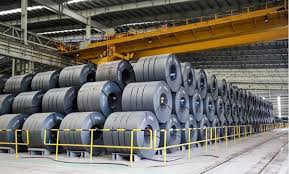
Coiling: Once the desired thickness is achieved, the steel is quickly cooled and wound into the heavy coils we see on trucks and trains.
Why is it a Commodity?
HRC is considered a “pure” commodity because it is fungible and standardized. A ton of HRC produced to a specific grade (like ASTM A1011) in India is functionally identical to a ton produced in the U.S. or China. This standardization allows it to be traded in bulk on global markets with predictable quality.
The Global Power Players
The steel market is a game of scale.
-
Biggest Manufacturer: China Baowu Steel Group currently leads the world, followed by ArcelorMittal (Luxembourg/Global) and Ansteel Group (China).
-
Top Exporters: China is the undisputed king of exports, followed by Japan and South Korea.
-
Top Importers: The United States, Vietnam, and the European Union are typically the largest buyers, driven by their massive manufacturing and construction sectors.
Industries Fueling Demand
HRC is the “raw material’s raw material.” It is indispensable to:
-
Automotive: Frames, chassis, and wheels.
-
Construction: I-beams, structural tubing, and roofing.
-
Energy: Large-scale oil and gas pipelines and wind turbine towers.
-
Machinery: Heavy equipment for agriculture and mining.
-
Appliance Manufacturing: The internal skeletons of “white goods” like washers and dryers.
Price Dynamics: Supply, Demand, and Geopolitics
HRC prices are notoriously volatile, acting as a “canary in the coal mine” for the global economy.
1. Market Supply and Demand:
-
The China Factor: Since China produces over 50% of the world’s steel, a slowdown in Chinese construction (real estate) immediately leads to a global surplus, crashing prices.
-
Input Costs: Prices of iron ore and coking coal are directly baked into HRC costs. If mining strikes occur in Australia or Brazil, HRC prices spike.
2. Geopolitical Factors:
-
Trade Barriers: Tariffs (like the U.S. Section 232) can decouple domestic HRC prices from global benchmarks, creating “price islands.”
-
Conflict: The Russia-Ukraine war significantly disrupted supply, as both nations were major exporters of pig iron and slabs (the precursors to HRC) to Europe.
-
Decarbonization: As nations move toward “Green Steel,” older blast furnaces are being shuttered. The cost of transitioning to hydrogen-based production is currently adding a “green premium” to HRC prices.
Beyond the Coil: HRC as a Raw Material
HRC isn’t just a finished product; it’s the precursor to even more refined materials. If a factory needs a smoother finish or thinner gauge, they perform Cold Rolling.
HRC is also the base for Galvanized Steel (zinc-coated to prevent rust) and Tinplate. Without a steady supply of hot-rolled coils, the production lines for everything from food cans to high-end electronics would grind to a halt.
Whether you are looking at it through the lens of a stock market analyst or a civil engineer, HRC Steel remains one of the most vital pulses to monitor in the global industrial landscape.