In the high-stakes world of global commodities, few substances are as versatile, politically charged, or chemically fascinating as ethanol. Often dismissed as just “the stuff in our gas,” ethanol is actually a multi-billion-dollar linchpin of the modern economy. It sits at the intersection of agriculture, energy, and environmental policy—a triple threat that makes it one of the most significant commodities of the 21st century.
Whether you are a commodity trader, a sustainability advocate, or just someone wondering why your local gas pump mentions “10% Ethanol,” understanding this liquid is essential.
The Chemical DNA: Why We Use Ethanol
Before we look at the massive silos of corn in Iowa or the sprawling sugarcane fields of Brazil, we must understand the molecule itself. Ethanol (ethyl alcohol) has the chemical formula $C_2H_5OH$.
1. High Octane Rating
Ethanol is a natural octane booster. In internal combustion engines, a higher octane rating prevents “knocking”—the premature combustion of fuel that can damage engines. Pure ethanol has an octane rating of approximately 108 to 110, significantly higher than standard gasoline.
2. Oxygenation and Clean Burning
Ethanol contains oxygen in its molecular structure. When blended with gasoline, it helps the fuel burn more completely, which reduces tailpipe emissions of carbon monoxide ($CO$) and particulate matter.
3. Solvency and Polarity
Chemically, ethanol is a polar solvent. This means it can dissolve both water-based and organic substances. This dual nature is why it is the “gold standard” solvent for everything from perfumes to hand sanitizers.
4. Hygroscopic Nature
One challenge is that ethanol is hygroscopic—it loves water. It will literally pull moisture out of the air. This characteristic is why ethanol cannot be easily transported in existing oil pipelines (which often contain trace water) and must be shipped via rail, barge, or truck.
From Field to Fuel: The Industrial Production Process
How do we turn a starch-heavy ear of corn or a sugary stalk of cane into a high-grade fuel? There are two primary industrial pathways: Dry Milling and Wet Milling.
The Dry Milling Process (Most Common)
About 90% of ethanol in the U.S. is produced via dry milling because it is cost-effective and produces valuable co-products.
-
-
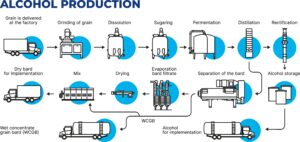
Milling: The entire grain is ground into a fine flour (meal).
-
Liquefaction: The meal is mixed with water and enzymes (alpha-amylase) to break down starch into complex sugars.
-
Saccharification: More enzymes (glucoamylase) are added to convert those sugars into simple glucose.
-
Fermentation: This is where the magic happens. Yeast (Saccharomyces cerevisiae) is added to the “mash.” The yeast eats the glucose and excretes ethanol and $CO_2$.
-
Distillation: The resulting “beer” is only about 10-15% alcohol. It is heated in distillation columns to separate the ethanol from the water and solids.
-
Dehydration: Ethanol and water form an azeotrope at 95%. To get to 99% (fuel grade), it is passed through molecular sieves (zeolite beads) that trap the remaining water molecules.
-
The Wet Milling Process
In wet milling, the grain is first “steeped” in water and dilute sulfurous acid. This allows the processor to separate the grain into its constituent parts: starch, fiber, gluten, and germ. While more complex, it allows for the production of high-value products like corn oil and high-fructose corn syrup alongside ethanol.
Where the World’s Ethanol is Made
Ethanol production is a game of geography. You need land, water, and the right climate.
| Region | Primary Feedstock | Market Share (Approx.) |
| United States | Corn (Maize) | ~53% |
| Brazil | Sugarcane | ~28% |
| European Union | Wheat / Sugar Beets | ~5% |
| China | Corn / Cassava | ~3% |
| India | Molasses / Sugarcane / Corn | ~3% (Growing rapidly) |
The “Atmospheric” Advantage
Manufacturing ethanol isn’t just about the crops; it’s about the environment of the plant.
-
Growing Conditions: Corn requires consistent rainfall and temperate summers. Sugarcane needs tropical heat and high humidity.
-
The “Summer Slowdown”: Ironically, high ambient temperatures can actually hinder ethanol manufacturing. Fermentation is an exothermic process (it generates heat). If the atmospheric temperature is too high, the cooling towers of a plant can’t dissipate heat fast enough. This “atmospheric stress” on the yeast can lead to lower yields, which is why many plants experience a production dip during humid summer months.
Global Trade: The Biggest Importers and Exporters
In 2025 and 2026, the ethanol trade has reached record volumes.
-
Top Exporters: * USA: The undisputed king. In 2025, the U.S. exported over 2.1 billion gallons, primarily to Canada, the UK, and India.
-
Brazil: A major exporter, though they often consume much of their own production in their “Flex-Fuel” vehicle fleet.
-
-
Top Importers:
-
Canada: The largest buyer of U.S. ethanol to meet its strict “Clean Fuel Regulations.”
-
European Union: Imports ethanol to meet its Renewable Energy Directive (RED III) targets.
-
India: While producing more locally, India still imports significant quantities for its aggressive E20 (20% ethanol) blending mandate.
-
Geopolitics: Who Pulls the Strings?
The price of ethanol isn’t just decided by the harvest; it’s decided in boardrooms and embassies.
-
Energy Sovereignty: For countries like India and the Philippines, ethanol is a way to reduce reliance on the OPEC+ oil cartel. By “growing” their fuel locally, they save billions in foreign exchange reserves.
-
The “Food vs. Fuel” Debate: This is the most persistent geopolitical friction point. When corn prices spike, critics argue that using food for fuel starves the poor. This leads to policy shifts—like China’s recent move to prioritize food security over biofuel expansion.
-
Trade Barriers: High tariffs are common. For example, the EU often imposes anti-dumping duties on U.S. or Brazilian ethanol to protect its local wheat farmers.
The Oil Connection: How Crude Prices Drive Ethanol
There is a “tether” between the price of a barrel of oil and a bushel of corn.
-
The Price Ceiling: Since ethanol is mostly used as a gasoline additive, its price is capped by the price of the gasoline it replaces. If Brent Crude prices crash, ethanol becomes less competitive.
-
The “Crush Spread”: Ethanol producers watch the “Crush Spread”—the difference between the cost of the raw grain and the value of the ethanol and co-products. When oil is high and corn is low, ethanol plants mint money.
Beyond the Gas Tank: Industrial Applications
While transportation takes the lion’s share, ethanol is a vital raw material in several other sectors:
-
Medical & Pharmaceutical: As a disinfectant (70% concentration kills most bacteria and viruses) and as a solvent in medicines.
-
Cosmetics: Found in colognes, lotions, and hairsprays because it evaporates quickly and carries scents well.
-
Chemical Synthesis: Used to make ethyl acrylate, vinegar (acetic acid), and even bio-plastics.
-
Food Industry: Used as a carrier for flavors (like vanilla extract) and as a preservative.
Policy and Subsidies: The Hidden Hand
The ethanol market is, in many ways, a constructed market. Without government mandates, the industry would look vastly different.
-
United States (RFS): The Renewable Fuel Standard (RFS) mandates that a certain volume of renewable fuel be blended into the nation’s gasoline supply every year.
-
The 45Z Tax Credit: New U.S. policies in 2025/2026 provide massive tax credits for ethanol with a low “Carbon Intensity” score.
-
India’s E20 Mandate: Prime Minister Modi’s government accelerated the target to reach 20% ethanol blending by 2025/2026, creating a massive, guaranteed domestic market.
-
Brazil’s RenovaBio: A sophisticated credit-trading system where ethanol producers earn “CBIO” credits for every ton of $CO_2$ they prevent from entering the atmosphere.
The Sustainability Debate: Ethanol vs. Fossil Fuels
Is ethanol actually “green”? The answer depends on how you measure it.
The Pro-Ethanol Case
-
Lifecycle Emissions: Modern studies suggest that U.S. corn ethanol has 40% to 50% lower greenhouse gas emissions than gasoline when looking at the entire lifecycle.
-
Carbon Sequestration: The crops (corn/cane) pull $CO_2$ out of the atmosphere while growing, effectively recycling carbon.
The Critics’ Case
-
Land Use Change: If forests are cleared to plant corn for ethanol, the “carbon debt” is huge.
-
Monocultures: Growing only one crop (like corn) year after year can deplete soil nutrients, leading to increased fertilizer use, which in turn causes nitrogen runoff into waterways (the “Dead Zone” in the Gulf of Mexico).
Why Is It Called the “Fuel of the Future”?
You might think the rise of Electric Vehicles (EVs) would kill ethanol. On the contrary, ethanol is evolving.
-
Sustainable Aviation Fuel (SAF): It is incredibly hard to power a Boeing 787 with batteries. However, you can turn ethanol into jet fuel (Alcohol-to-Jet). This is the “holy grail” for the airline industry to reach net-zero.
-
Cellulosic Ethanol (2G): We are finally mastering the technology to make ethanol from waste—corn stalks, wheat straw, and even municipal trash. This “Second Generation” ethanol doesn’t compete with food.
-
Carbon Capture: Ethanol plants produce a very pure stream of $CO_2$ during fermentation. By capturing this and pumping it underground, ethanol can actually become carbon-negative.
Impact on Local Farming Practices
Ethanol has fundamentally changed the life of the modern farmer.
-
Economic Stability: Ethanol provides a “floor” for grain prices. Farmers are no longer just selling food; they are energy producers.
-
The Co-Product Factor: When you make ethanol from corn, you only use the starch. The protein, fiber, and oil remain. This becomes Distillers Dried Grains with Solubles (DDGS)—a high-protein animal feed. This means the “Food vs. Fuel” argument is a bit of a misnomer; you get both fuel and feed from the same kernel.
Conclusion: The Liquid Bridge
Ethanol is more than just a commodity; it is a bridge. It is a bridge between the fossil-fueled past and a decarbonized future. It is a bridge between rural agriculture and urban energy needs. While it faces competition from electrification, its chemical unique properties—its octane rating, its role in aviation, and its potential for carbon-negative production—ensure that it will remain a titan of the global economy for decades to come.
As we move through 2026 and beyond, the “liquid gold” will likely get even greener, shifting from the cornfields of the Midwest to the high-tech biorefineries that turn waste into wings.