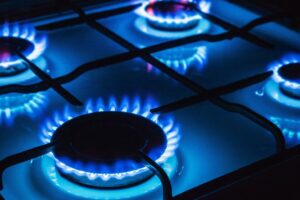
When most people think of propane, they picture a summer afternoon, a backyard grill, and the faint, sulfurous scent of a “rotten egg” warning them that the valve is open. But in the world of global commodities, the humble blue flame of your barbecue is just the tip of a massive, multi-billion dollar iceberg.
Propane, a versatile hydrocarbon often referred to as Liquefied Petroleum Gas (LPG), is a critical cog in the machinery of modern civilization. From drying the world’s grain to serving as the literal building block for the plastics in your smartphone, propane is far more than just a camping accessory. As we move deeper into 2026, the strategic importance of this commodity has only intensified.
1. The Chemical DNA: What Exactly is Propane?
At its core, propane is a three-carbon alkane with the chemical formula $C_3H_8$. In its natural state, it is a colorless and odorless gas. The distinct “rotten egg” smell we associate with it is actually an additive called ethyl mercaptan, a safety measure designed to help humans detect leaks.
Key Chemical and Physical Properties:
-
Molecular Weight: $44.097 \text{ g/mol}$
-
Boiling Point: $-42.1^\circ\text{C}$ ($-43.8^\circ\text{F}$)
-
Energy Density: High. It packs a significant punch for its volume, making it an efficient fuel for transport and heating.
-
State of Matter: At standard atmospheric pressure, it is a gas. However, it easily liquefies under moderate pressure. This is its “superpower”—it can be stored as a liquid in relatively light tanks but used as a gas, making it highly portable.
-
Combustion Reaction: When propane burns in the presence of sufficient oxygen, it undergoes a clean combustion:
C3H8 + 5O_2 (rightarrow )3CO_2 + 4H_2O + {Heat}This efficiency makes it a “bridge fuel” in the transition toward lower-carbon energy sources, as it emits significantly less CO2 than coal or heavy oil.
2. Production: Where Does Propane Come From?
Contrary to popular belief, propane is not “mined” as a standalone substance. It is a co-product. You cannot set out to find a “propane field.” Instead, it is captured during two primary processes: Natural Gas Processing and Crude Oil Refining.
A. Natural Gas Processing (The Primary Source)
About 60–70% of the world’s propane comes from the processing of “wet” natural gas. When raw natural gas is extracted from the earth, it isn’t just methane ($CH_4$). It contains a cocktail of Natural Gas Liquids (NGLs), including ethane, propane, butane, and pentane.
To make natural gas “pipeline quality,” these NGLs must be removed to prevent them from condensing into liquids inside the pipes. This is done through cryogenic expansion—cooling the gas to extremely low temperatures so the different hydrocarbons “drop out” at their respective boiling points.
B. Crude Oil Refining
The remaining 30–40% of propane is a byproduct of the stabilization and cracking phases of oil refining. As heavy crude oil is broken down into gasoline, diesel, and jet fuel, lighter gases like propane rise to the top of the distillation towers.
3. Extracting the Energy: Drilling from Land
The journey of propane begins miles beneath the earth’s surface. In the last decade, the method of “drilling from land” has been revolutionized by the Shale Revolution, particularly in the United States.
The Seven Steps of Extraction:
-
Site Preparation: Access roads and pads are built to support massive drilling rigs.
-
Vertical Drilling: A drill bit grinds straight down through layers of rock, often to depths of 5,000 to 10,000 feet.
-
Horizontal Steering: Once the drill reaches the “kick-off point” above the target shale layer, advanced sensors and motors turn the bit 90 degrees, allowing it to travel horizontally for miles within the thin layer of gas-rich rock.
-
Casing and Cementing: Steel pipes (casing) are inserted and cemented to prevent any gas or fluids from leaking into freshwater aquifers.
-
Perforation: A “perforating gun” fires small explosive charges into the horizontal section, creating tiny holes in the rock.
-
Hydraulic Fracturing (Fracking): A high-pressure mixture of water, sand, and minor chemical additives is pumped into the well. This opens up “paper-thin” cracks in the shale, allowing the trapped gas and NGLs (including propane) to flow out.
-
Production: The mixture of gas and liquids is brought to the surface, separated, and sent via pipeline to a fractionation plant.
4. The Global Power Players: Producers, Exporters, and Importers
The propane market is a geopolitical chessboard. Because it is tied to natural gas and oil production, the leaders in those sectors naturally dominate propane.
The Giants: Top Producers (2025-2026 Data)
-
United States: The undisputed heavyweight, producing over 2 million barrels of NGLs per day, largely from the Permian and Appalachian basins.
-
China: A massive producer, though most of its output is consumed internally by its booming petrochemical sector.
-
Russia: Despite sanctions, Russia remains a top producer, supplying its domestic markets and “shadow” export routes.
-
Saudi Arabia & UAE: High-volume producers whose propane is a byproduct of their massive oil operations.
-
Canada: A major North American player with significant NGL output from the Western Canadian Sedimentary Basin.
The Sellers: Biggest Exporters
The United States is currently the world’s largest propane exporter. Thanks to the shale boom, the U.S. produces far more propane than it can use, shipping the surplus from terminals in Houston (Enterprise/Targa) and Marcus Hook (Pennsylvania). Other major exporters include Qatar, Canada, and Algeria.
The Buyers: Biggest Importers
-
China: The ravenous appetite of China’s Propane Dehydrogenation (PDH) plants makes it the world’s largest importer.
-
Japan: Highly dependent on LPG for residential heating and industrial use.
-
India: The government’s “Ujjwala” scheme has converted millions of households from wood-burning to propane, making India a critical growth market.
-
Mexico: Uses propane for the vast majority of its residential cooking and heating needs.
5. Propane as a Traded Commodity
Propane is a highly liquid (pun intended) financial asset. It is traded on major exchanges, allowing companies to hedge against price volatility.
-
Primary Benchmarks: The global “Gold Standard” for propane pricing is Mont Belvieu, Texas. Most international contracts are priced as a differential to this hub. In Europe, the benchmark is ARA (Amsterdam-Rotterdam-Antwerp), and in Asia, it is the Far East Index (FEI).
-
Exchanges: Propane futures and options are traded on the CME Group (NYMEX) and the Intercontinental Exchange (ICE).
-
Contract Size: A standard NYMEX propane futures contract represents 42,000 gallons (the approximate capacity of a rail car).
-
Price Drivers: Propane prices are “sandwiched” between two worlds. They often track Crude Oil (the feedstock) but are also heavily influenced by Natural Gas inventory levels and Weather (cold winters spike demand for heating).
6. Industrial Applications: More Than Just Grilling
The versatility of propane makes it a “Swiss Army Knife” of fuels. Here is how it is utilized across various sectors:
A. The Petrochemical Industry (The Plastic Connection)
This is the “hidden” side of propane. Large industrial facilities called PDH Plants (Propane Dehydrogenation) take propane and strip away hydrogen atoms to create Propylene. Propylene is the precursor to Polypropylene, a plastic used in everything from car bumpers and medical syringes to food packaging and textiles.
B. Agriculture: The Farmer’s Best Friend
In rural areas where natural gas pipelines don’t reach, propane is king.
-
Grain Drying: After harvest, crops like corn and soybeans must be dried to prevent mold. Propane-powered dryers provide the high, consistent heat needed for this.
-
Flame Weeding: Organic farmers use propane torches to “shock” weeds, killing them without the use of chemical herbicides.
-
Irrigation: Propane-powered engines pump water from deep wells to thirsty fields.
C. Transportation: Autogas
Propane is the world’s third most popular vehicle fuel. Known as Autogas, it powers school buses, delivery vans, and taxi fleets. It is favored for its lower particulate emissions and lower cost compared to diesel, especially in “indoor” environments like warehouses where propane forklifts are the industry standard because they don’t produce toxic fumes like gasoline.
D. Manufacturing and Metalworking
Propane’s high flame temperature makes it ideal for:
-
Soldering and Brazing: Precision heating for plumbing and jewelry.
-
Glass Blowing: Furnaces that require steady, clean heat.
-
Paint Curing: Large-scale industrial ovens for drying automotive paint.
7. The Future: Bio-Propane and Sustainability
As the world pushes toward “Net Zero,” the propane industry is evolving. Bio-Propane (rLPG) is now being produced from renewable feedstocks like used cooking oil and plant fats. It is chemically identical to conventional propane but has a carbon footprint up to 80% lower. This ensures that the infrastructure we’ve built for propane—the tanks, the trucks, and the pipelines—will remain relevant for decades to come.
Conclusion
Propane is a fascinating commodity. It is a byproduct that became a necessity; a gas that acts like a liquid; and a rural heating fuel that became a global industrial feedstock. Whether you are an investor looking at the spread between Mont Belvieu and the Far East Index, or a homeowner simply looking to stay warm, understanding propane is essential to understanding the modern energy landscape.